• About
  • Blog (Ext.)
  • BOOKS
    • AURELIUS
    • FIRST CRUSH (Preview)
    • GET OUT!
    • JUDGING ATHENA
    • Perrin On Politics
    • SOLD OUT
    • The Happy Little Cigar Book
    • THE SUBSTITUTE
  • Contact
  • Education Resources
  • News Links

PERRIN LOVETT

~ Deo Vindice

PERRIN LOVETT

Tag Archives: Chris Orcutt

The Black Pit of Literature

10 Tuesday Nov 2026

Posted by perrinlovett in fiction, News and Notes

≈ Comments Off on The Black Pit of Literature

Tags

BTTA, Chris Orcutt, writing

Chris Orcutt writes about BTTA and the perils and rewards of the writing process. He uses a very clever analogy.

Of course when I reach port one year from now, I’m hoping there will be a much larger crowd of fans, readers, book buyers, supporters, journalists, etc. than the crowd that saw me off at the beginning. I’m confident this is what will happen. But while crossing the Black Pit, I had a realization.

Even if there’s no one at the destination to greet me next year, it doesn’t matter because I will have accomplished something unequivocally, indisputably great. I will have safely shepherded a nine-book convoy across an overwhelming chasm of ocean, and done it to the absolute best of my ability.

I will have given the books everything I have, and I know they will stand the test of time. And even if I were to die soon thereafter, the books I leave behind are forever.

Please read the whole thing at Chris’s blog.

BOOK REVIEW: Bodaciously True & Totally Awesome, Episode IV: Secret Lovers by Chris Orcutt

06 Tuesday Oct 2026

Posted by perrinlovett in Other Columns

≈ Comments Off on BOOK REVIEW: Bodaciously True & Totally Awesome, Episode IV: Secret Lovers by Chris Orcutt

Tags

1980s, book review, BTTA, Chris Orcutt, fiction, SECRET LOVERS

Bodaciously True & Totally Awesome, Episode IV: Secret Lovers by Chris Orcutt

Review by Perrin Lovett


Say, friends, do you enjoy a good visible polyrhythm? Yeah, I didn’t know that was a thing either, not until I read chapter 21 of today’s subject work of incredible fiction. But trust me, you’ll enjoy it: the dance moves, something Robert Palmer’s dancers would have shimmied along with, and the book. And that book is Secret Lovers, the fourth episode in Chris Orcutt’s Bodaciously True & Totally Awesome, the epic that literally brings the 1980s back to life. 

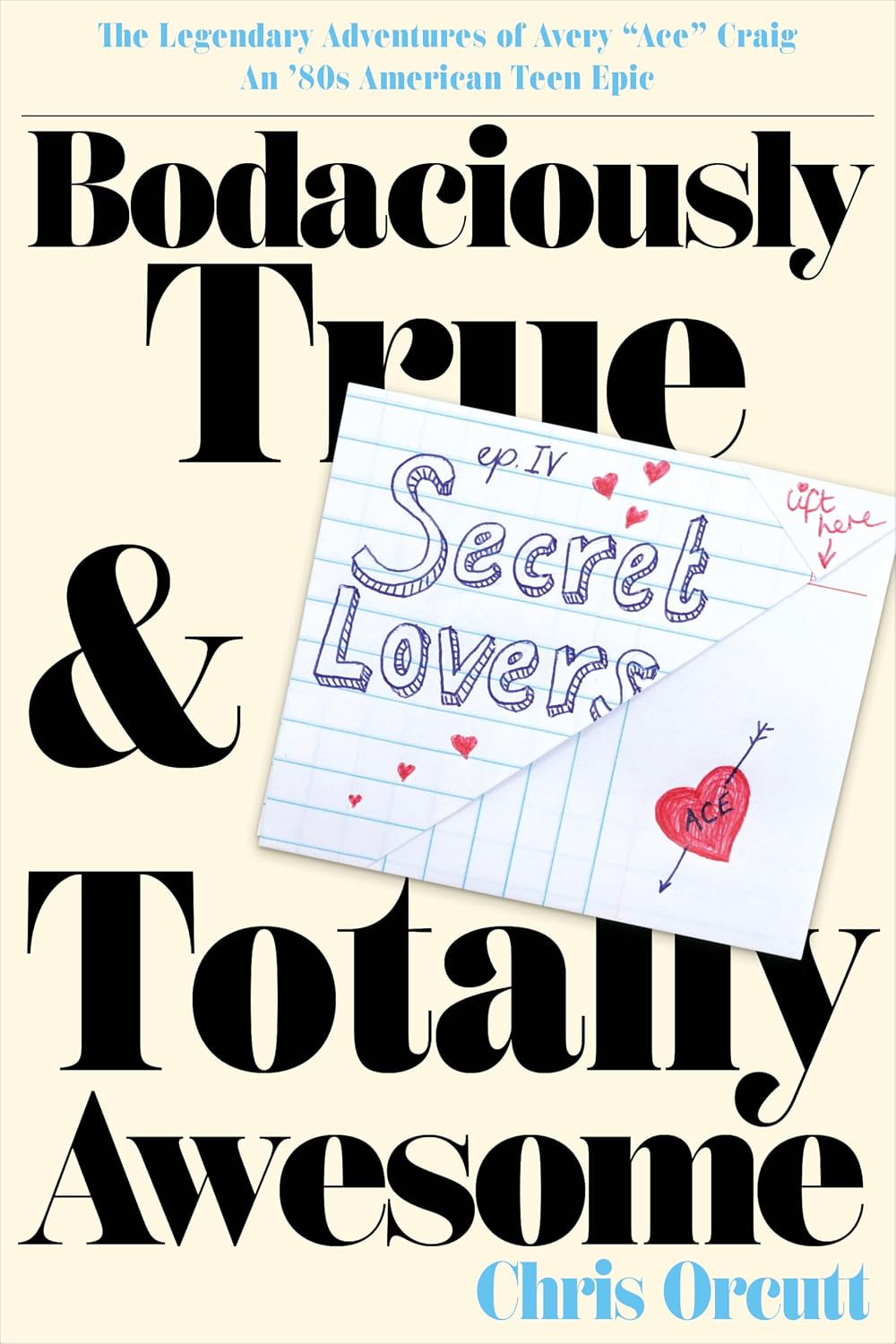
(©Have Pen, Will Travel. Cover design by Victoria Heath Silk.)

*Orcutt, Chris, Bodaciously True & Totally Awesome, Episode IV: Secret Lovers, New York: Have Pen, Will Travel, 2026.

New York novelist Chris Orcutt has three solid decades of experience crafting literature, with one of them dedicated almost exclusively to writing Bodaciously True & Totally Awesome (BTTA), a masterpiece roughly the length of In Search of Lost Time (Remembrance of Things Past) by Proust. Your reviewer had not really considered it before, but many of Orcutt’s themes in BTTA run along the same lines as those in Remembrance—young love, growing up, timing, appreciation of the arts, et cetera. Orcutt provides a new take on all of those familiar motifs, doing so abnormally well, while integrating elements Proust never touched on, such as action and adventure. Of course, the era and scene-setting are completely different. And that difference makes BTTA especially interesting to America’s Generation X: this is our memory of the past, of a time lost to four decades of temporal transit. And with Episode IV, Secret Lovers, Orcutt brings the past back to life in a way perhaps no other author has ever dared. On full display is Orcutt’s creative genius, impeccable precision, and nearly surreal attention to every little detail. Four episodes in, Secret Lovers might be your reviewer’s favorite so far. Why? Part of it has to do with much of the nostalgia I’ve mentioned in my previous reviews. But the main reason is that it is simply a damned good story! So let’s dive right in.

I hereby incorporate all points of my previous reviews of Bad Boy, True Blue, and Danger Zone as if each point were restated in full. In Secret Lovers, the literary roller coaster goes so fast and hard that one might be well-advised to go limp and just let it ride. Avery “Ace” Craig keeps up the heroic questing readers have come to expect and enjoy as he intrepidly ventures into new territory, all of it set to our glorious 1980s music. The pop-rock flows, as do more classical themes. Orcutt even breaks down the exact timing within a few tunes he references: see “Bugler’s Dream and Olympic Fanfare Medley” on page 35. Also, “The Devil Went Down to Georgia” never hurt any book!

As with the other episodes, Secret Lovers shifts gears again — ”drop a gear and disappear,” as the saying goes. This time, instead of slowing, as in Danger Zone, the days roll right along in the story, though each part and act is examined in close detail. And there is an intensification covering many fronts. The result is a thrilling experience that will have the reader on the edge of his seat, scratching his head, pondering, cheering, fearing, and feeling a sense of awe. In short, it’s a spectacular book. And Orcutt has plenty of room to work, as Secret Lovers is the longest episode yet, 422 pages of riveting dramatic exhibition. The book’s chapters are not named—a point I think I failed to make previously; rather, each major scene within a chapter has its own catchy subtitle. For example, on or about page 257, the subtitle is “Gemma’s Fault.” But is it really? One will have to read chapter 17 to find out. Also, speaking of finding out, I’ll bet the seasoned reader likes Gemma. Right? And there’s a chance that more than a few Gemma fans liked those ‘80s video games. What if both of those likes were somehow combined? Read and see; you’ll dig it like a bee on pollen.

As the book opens, Avery sets about resolving the cliffhanger from the end of Danger Zone. Through great wit, selflessness, determination, and muscle, he saves himself and the two ladies he’s trapped with. By now, you know they’re Gemma and Beverly. Orcutt inserts a neat reference to Pheidippides during the sequence, and Avery creates his own legend, replete with a daydream, honors, and a bit of notoriety. His fame, however, leads to the loss of Penny as a girlfriend, something our hero had been contemplating anyway. Relief? Not exactly; from there things get complicated.

The reader will have to discover for himself who the title refers to, and there might be more than one choice or way of looking at matters. Here, I note that Orcutt does a fascinating job going inside the male mind, along with a look at its feminine counterpart. Things quickly escalate! Just when things feel cozy with Gemma, Caitlyn Cray returns. Avery is not opposed to the concept of the “side piece,” as they call her on the street. Nor does he turn down the chance to coach a gaggle of lovely young ladies towards a talent show victory. He also receives what might be the longest and deepest love note in literary history. The law gets involved. Again. And to make Pa happy, if or when Pa finds out, Avery flips the script and uses Latin in geometry class! Of course, he’d better come up with something soon, as there’s a problem with the latter subject. Regarding that problem, he now has an ally, though as of the end of Secret Lovers, they still haven’t concocted a plan that works. Towards the end, Avery even deals with a pesky Gamma stalker. And in the “Jones-Craig Alliance” sequence in chapter 24, he also has to contend with good, old-fashioned suave pretentiousness as it takes aim at his girl. One of them, anyway.

The whole plot moves along fluidly and rapturously thanks to Orcutt’s writing style, exorbitant attention to detail, and lucid imagination. Again, most uncannily, the time in Secret Lovers flows on as it did in the first two episodes; concurrently, keen consideration is given to everything, a detailed exploration just like in Danger Zone. Avery and company walk, run, struggle, and play in a world of details, those ordinary and highly unusual. 

As for the commonplace, it’s really more a matter of light or familiar things, like Orcutt’s use of the bygone department store, Caldor. There’s just something about it. I cannot recall whether I ever visited a Caldor store in person, back in the day; however, with Orcutt’s you-are-there storytelling, I might as well have. As an example of serious matters, the Chernobyl nuclear disaster is presented in an interesting context. 

Something very unusual and serious happens. Readers may know by now that Avery does a little moonlighting work for one of Uncle Sam’s alphabet agencies. In Secret Lovers, chapter 15, he gets involved with another one. See pages 212-232. I’ll not give the process away here, a form of junior “sheep dipping,” but Orcutt presents the matter convincingly and more realistically than one might imagine is possible. And this kind of scenario is not only possible, but very real. In fact, the situation comes across very much like what Udo Ulfkotte describes in Gekaufte Journalisten (Bought Journalists) and his own youthful recruitment by the West German BND. The gubmit recruiter nails two of Avery’s weaknesses, one of which is, as one might imagine, his susceptibility to influence by the fairer sex. While Orcutt’s usage is, of course, fictional, please know that the kind of thing he’s bringing to life really does exist. The scene is excellent and foreshadows the coming episodes of BTTA. We’ve got something to truly look forward to. Know that Avery may be hard-pressed in the future.

He’s already pressed, mostly concerning girls, as-is. Caitlyn and Gemma would be enough, but he also has loose ends and loose screws to wrap up with Inge and Irina. And more ladies too. The boy is smart, wicked smart, but he is sixteen. He spends a lot of the book wondering what he’s doing and why. The reader will ponder along with him. This installment really hit on all cylinders concerning the reading balance between your reviewer’s teenage past and his cresting-the-hill present. 

Secret Lovers ends with another cliffhanger. And the current suspenser has several parts: a ruse to placate an elderly neighbor; and two young women, mere feet apart, whose meeting would be catastrophic. The very end takes place in a gallery hall at the NYC Met. Unlike Caldor, I know for certain I have been to the Met. In fact, I’ve been in that gallery hall leading back to the lobby and exit. Here, despite Orcutt’s excellent description, I still can’t precisely recall my own experience there. Call it a vexing pleasure, something to be expected from this epic: BTTA: Where reading is always a pleasure.

Bodaciously True & Totally Awesome, Episode IV: Secret Lovers is, like the other episodes, a mandatory read. It launches on October 20, 2026, so pre-order it today. While you’re waiting, and if you’re not already up to speed, please review the following:

  • My interview with Chris Orcutt.
  • Episode I: Bad Boy is available on Amazon. Please read my review.
  • Episode II: True Blue is also on Amazon. My review.
  • Episode III: Danger Zone is on Amazon. My review.


BOOK REVIEW: Bodaciously True & Totally Awesome, Episode III: Danger Zone by Chris Orcutt

29 Monday Jun 2026

Posted by perrinlovett in Other Columns

≈ Comments Off on BOOK REVIEW: Bodaciously True & Totally Awesome, Episode III: Danger Zone by Chris Orcutt

Tags

Bodaciously True and Totally Awesome, book review, BTTA, Chris Orcutt, Danger Zone, fiction

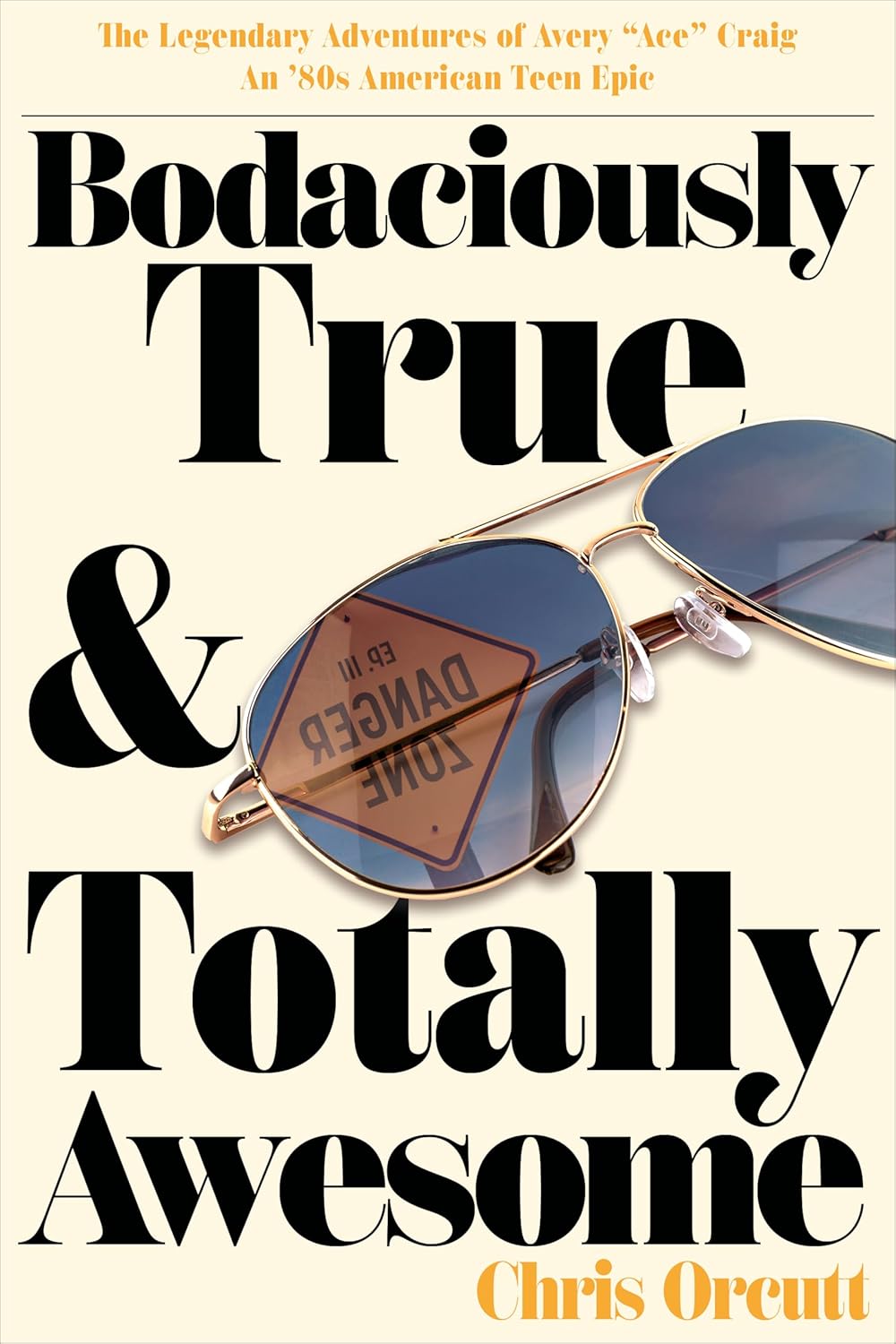
Bodaciously True & Totally Awesome, Episode III: Danger Zone by Chris Orcutt

Review by Perrin Lovett


On Monday, April 21, 1986, millions of Americans tuned in to watch Geraldo Rivera open Al Capone’s vault. After weeks of hype and two hours of slow torture, we found out that the vault contained nothing. Remember that? Well, ready or not, it’s time to go back to 1986. And no one can take us there like Chris Orcutt. Bodaciously True & Totally Awesome, Orcutt’s nine-part epic novel about teenage life in the penultimate decade of the twentieth century, continues. Here follows a brief look at Episode III: Danger Zone. Unlike Capone’s, Orcutt’s ink-and-paper vault contains everything.

(Cover design by Victoria Heath Silk.)

*Orcutt, Chris, Bodaciously True & Totally Awesome, Episode III: Danger Zone, New York: Have Pen, Will Travel, 2026.

Chris Orcutt is the author whom many correctly regard as the American Tolstoy and whom I’ve previously called “the best American novelist alive today.” I’ve also proclaimed that Orcutt has joined the ranks of the greats—Homer, Ovid, Chaucer, Shakespeare, Pushkin, Gogol, Murakami, et al. Once again, with Danger Zone, he does not disappoint. With three decades of experience, Orcutt approaches his literature with a keen ear and voice, an impressive attention to detail, and an unswervingly creative imagination. Before this review commences in full, please consider the following bookkeeping items:

    • My interview with Chris Orcutt.
    • Orcutt’s video interview with Danielle Hutchinson.
    • Episode I: Bad Boy is available from Amazon. Please read my review.
    • Episode II: True Blue is also on Amazon. My review.
    • Episode III: Danger Zone launches on July 7, 2026. Pre-order it today.

I hereby incorporate all points of my previous reviews of Bad Boy and True Blue as if each point were restated in full. Summarily updating a few of them for Danger Zone, I advise that the reader is still on a thrilling literary roller coaster ride. Avery “Ace” Craig continues to endear himself to readers. He is still the archetypal ladies’ man. Orcutt’s writing is once again perfect. And once again, the physical book is a monument to literary art. The philosophy, rhythm, and tone of the whole work play out seamlessly, a condition that will have the reader, regardless of his age, right there, participating in the excitement. Avery is still trying on spiritual or philosophical hats, as Orcutt puts it, some of them self-serving, see on or about page 252, but that is to be expected from a young man confronting adulthood in the decade when Generation X rose into full self-awareness. Finally, the reader had better be ready, because the endless parade of 1980s music rocks on! 

As with True Blue, Danger Zone contains a subtle shift. Orcutt keeps developing Avery’s world, but he slows down just a little, allowing his protagonist (and readers) to look around with a bit more concentrated focus. And right off the bat, your reviewer focused on something that is semi-palpable in the first two episodes, and which is now brought to light. Avery is a master of language. And he is overly gifted with hand-eye coordination. Therefore, I had previously found it curious that he struggles with two particular subjects in school. If one has read Bad Boy and True Blue, one might have caught it as well. I wasn’t going to mention it, but “Pa” did it for me. Just like I once did, Avery calls one of his grandfathers “Pa.” That’s cool enough as-is. But Pa, while entertaining one of Avery’s three hundred love interests, remarks about his grandson’s schooling. Sweet Penny goes right along: from around page 22:

[Pa]: “Your boyfriend here’s a pretty bright fella, but he can’t do Latin—”

[Penny]: “Or geometry—”

[Pa]: “To save his life…”

That’s the “what” of it; I’ll leave the “why” to the reader’s discovery and/or imagination, one of many, many things to think about.

While addressing unusual academic issues, Danger Zone does not shy away from examining various family dynamics. All of it is presented non-polemically as a series of scenes and dialogues. Some of it is charming, while other parts are a little disturbing. The reader will be reminded that we are as we are, sometimes with the caveat of “alas.” The reader will find great interest in Avery’s heated discussion with Penny’s father, among other items. A lot of the drama comes from Penny and Avery’s other girlfriends. Early in the saga, I had my hopes up for one particular romance, but… Let’s say that Orcutt delivers a script in which one cannot be exactly certain of what is about to happen, only knowing that whatever it is, it’s going to be good. And if one analogizes Avery’s love interests to baseball, then this episode might just be the inning when he hits that elusive first home run. Thrills abound, both new ones and carryovers from the previous episode. 

As I noted, the music we all remember rolls on. Here, I select two tunes for reference. At just the right time, Orcutt treats us to “Private Idaho” by the B-52s and, a little later, “Your Love” by The Outfield. I was going to mention that there’s a great video of Tony Lewis performing the latter song live in 2018. Ahem. But Orcutt has all that covered and more: each episode comes with a FREAKING AWESOME 80s playlist on Spotify. Groove along with Ep. III if one will. And one should. 

Danger Zone ends with another cliffhanger. The setup is very interesting, and we are left with our hero and two friends (yes, it’s Avery, so their women) literally hanging off a cliff. (Down a hill is like off a cliff.) The preceding scene is short and simple enough, and contains a modicum of foreshadowing. But the reader ends his reading on the edge of his seat—kind of like the characters. With six more episodes to go, it stands to reason that they escape. But as for how, we will have to trust the author. 

He’s earned our trust. And we will have to wait to find out. I mentioned it once before, but the pause between these titles is mildly vexing. But that’s an homage in and of itself; reading every episode is a great pleasure. Episode IV, Secret Lovers, will be released in October of 2026. And one day! One day, the whole book will sit on the shelf awaiting a full, non-stop reread. I trust you, gentle reader, have cleared a foot or so on the bookcase.

Spoiler alert! Danger Zone is a hair shorter than the previous installments. But that is more than okay, as, in my estimation, this episode slows down and focuses. It’s a win-win because, as the whirlwind abates just a little, and Ace and Company hone in on a few things, so too will the reader. I caught myself dwelling on details of all kinds. And I’m sure the reader’s experience will be similar. Remember Wall Street with Charlie Sheen? That movie flew by, but when it slowed a little, like when Gordon Gekko spoke to Bud Fox on the phone from the beach that morning, the scene packed an extra punch. If “money never sleeps,” then Avery Craig never loses. Cheer on his latest exploits in Bodaciously True & Totally Awesome, Episode III: Danger Zone. Once again, it’s a mandatory read.

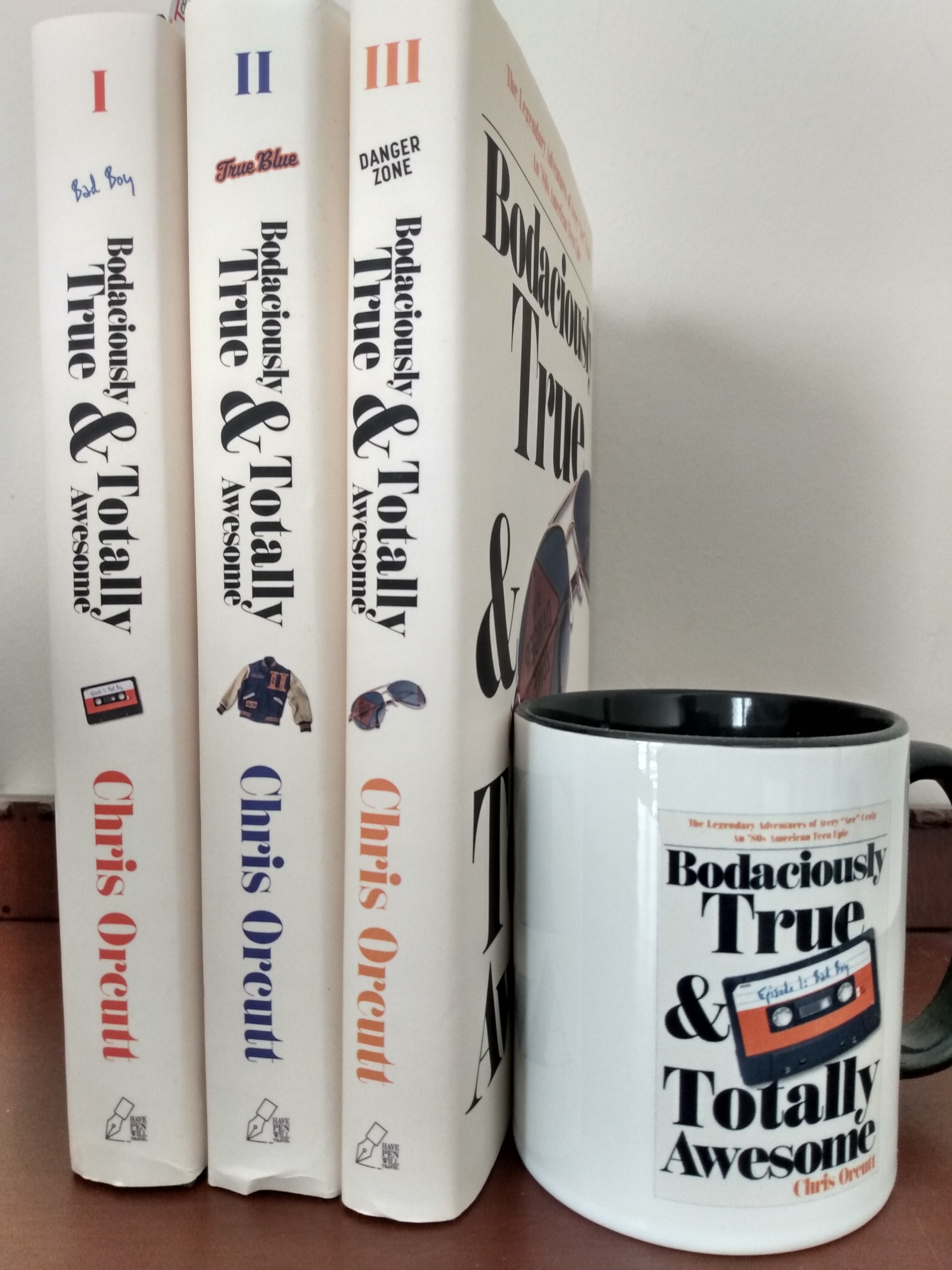
Bonus! Here’s what BTTA looks like, as-is, and this is only a third of the whole book!

And good luck finding the coffee cup! 😉

On the Art of Writing Novels and More

19 Sunday Apr 2026

Posted by perrinlovett in fiction, Other Columns

≈ Comments Off on On the Art of Writing Novels and More

Tags

Chris Orcutt, writing

Here follows Christ Orcutt’s full interview with the amazing Danielle Hutchison.

In addition to talking about BTTA, he goes deep into the art and science of what makes a writer tick and how one can or should face the craft today. If you’re a writer and/or a reader, then this is for you. Pay close attention to what he says about writing being the only art form where outside assistance is expected. I’ve never before heard the comparisons he makes, but he is dead on the money. Some help for the author — proofreaders, artists, etc. — is beneficial. But with AI and other modern innovations, it simply is not mandatory now. And the old dinosaur ideas about “the way” to publish a book are dead and buried in a mad world without rules. Heck, the largest book retailer in the world is trying to kill books entirely. Increasingly, it’s either the author’s own way or absolutely nothing. Here’s one of the best interviews about writing around:

Chris Orcutt Interview Preview

11 Saturday Apr 2026

Posted by perrinlovett in News and Notes

≈ Comments Off on Chris Orcutt Interview Preview

Tags

Chris Orcutt

Authority on Demand launched a preview for lovely Danielle’s upcoming full interview with Chris Orcutt. Check that for the real deal — one won’t want to miss it. And, again, BTTA Ep. 2, True Blue comes out next week!

AND… Rumor has it that Danielle may also have something with yours truly ere too long. Chris handles himself very well. Me? I needed every bit of Danielle’s pro help I could get. 😉

BOOK REVIEW: Bodaciously True & Totally Awesome, Episode II: True Blue by Chris Orcutt

01 Wednesday Apr 2026

Posted by perrinlovett in Other Columns

≈ Comments Off on BOOK REVIEW: Bodaciously True & Totally Awesome, Episode II: True Blue by Chris Orcutt

Tags

Bodaciously True and Totally Awesome, book review, Chris Orcutt, True Blue

Bodaciously True & Totally Awesome, Episode II: True Blue by Chris Orcutt

Review by Perrin Lovett


Here we go again! Generation X, elders, young folks, it’s once again time to head back to the glory of the 1980s. Here’s another brief look at Chris Orcutt’s unfolding masterpiece, Bodaciously True & Totally Awesome. Specifically, it’s Episode II: True Blue. To butcher some Whitesnake lyrics, “here [we] go again on [our] own.” But, of course, we’re not alone. Far from it. Thanks to Orcutt, we’ve got some hellaciously good company for this particular tour de force down memory lane!

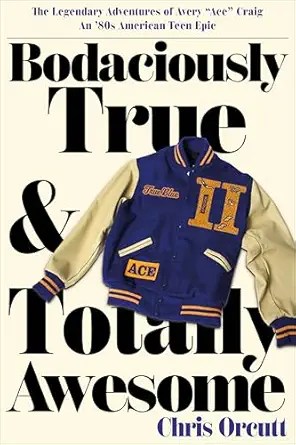
(Cover design by Victoria Heath Silk with image by Hurst Photo & Top Quality Vectors.)

*Orcutt, Chris, Bodaciously True & Totally Awesome, Episode II: True Blue, New York: Have Pen, Will Travel, 2026.

If necessary, please read my review of Episode I: Bad Boy. Please also read my interview with the author. Orcutt also gives a mean video interview! And if you’re just tuning in, then please buy a copy of both books (Bad Boy is now available, outright, and True Blue is available for pre-order) and fully acquaint yourself with Chris Orcutt, the author some regard (rightly) as the American Tolstoy and whom I’ve previously called “the best American novelist alive today.” I’ve also proclaimed, based on reading Episode I: Bad Boy, that Orcutt has joined the ranks of the greats—Homer, Ovid, Chaucer, Shakespeare, Pushkin, Gogol, Murakami, et al. With True Blue, he does not disappoint. 

Your reviewer herein incorporates all points of the Bad Boy review as if each were restated in full. I will now specifically summarize a few of them, updated for True Blue. Bodaciously… still moves like a roller coaster, although this time, there is a lot of snow, so kindly remember a parka and boots. Avery, the sixteen-year-old protagonist and James Bond fan, now acts out his admiration for Ian Fleming’s star character in gripping fashion. Once again, Orcutt’s writing is flawless. Again, my six-by-nine paperback is a marvel of literary engineering. Yet again, a spiritual or philosophical theory presents itself throughout the pages; Avery, as Orcutt put it in our interview, “is groping for meaning spiritually, kind of trying on different spiritual or philosophical hats.” As Orcutt said, this process was not deliberately inserted into the text. As I said, it is something the reader will discover and process on his own. Orcutt says, correctly, that a story is a story, not an argument. Of course, this particular story, like the better ones, comes with good examples and keen reminders—notes to engage the reader’s spirit and intellect. Avery continues to be a stellar ladies’ man, and his relationships, proceeding at a dizzying pace, add multiple aspects of excitement to the reading experience. That experience is further heightened by Orcutt’s deft usage of various historical elements, added via living incorporation, that take True Blue into territory where most novels simply cannot go. The reference footnotes keep rolling, and Orcutt even has one FOR TOLKIEN! (A big deal for your reviewer.) The exploration of human psychology continues, led valiantly by Avery, the alpha. Through all the new twists and turns, the reader, regardless of age or generation, will continue to feel and recall the attendant emotions and notions of youth. Oh, and the quintessence of our glorious 1980s music also continues! 

Now, without giving too much of the story away, here is a modicum of detail. True Blue presents a series of little reminders about things that have practically vanished from American life. Remember popping the clutch to bypass a dead battery? You will! Well, those over forty or fifty will. Remember high school employment? Avery takes a few interesting jobs, which, in addition to earning him money, further the excellent action and romantic themes of the book. There is a subtle shift, or intensification, in the story, wherein Orcutt expands on the groundwork previously laid out in Bad Boy. The refined, non-dialectical social commentary continues. For instance, Avery’s life and times, his adventures, are set betwixt and between his high school tenure. There is a long, well-woven subplot concerning the highs and lows of American education, particularly how it interferes with life and learning without necessarily adding much substance. In chapter seventeen, around page 313, a capstone is raised, more poignant than anything from, say, Ferris Bueller’s Day Off, that highlights the dichotomy. At precisely the right time, Avery kindly states the obvious: “It was amazing how much of school was superfluous.” John Taylor Gatto would have approved. (Note: I’m keeping the citations slightly rough [e.g., “around page…”] just in case any minor formatting adjustment moves anything a page or so.)

True Blue dives deeper into family dynamics, in general, and, especially, those concerning the late modern American period as typified by the 1980s. Several families are portrayed, each with its own flavor and characteristic. Without preaching or even trying to scene set, Orcutt exposes the good, the great, the not-so-good, and, frankly, the awful about how we live(d). Some of the material, all of it strikingly realistic and serious, feels a little dark and disturbing—and some of it is. Therein lies part of its literary beauty, as it accurately showcases the way we were, the way many of us have always been, and the way we still are today. There is no need to consult any edition of the APA’s DSM, but one will ponder why we, any of us, sometimes do the things we do, and how we tolerate our own ways and the ways of others. There is nothing in this thread to salvage, esoterically, per se, but Avery does use some of what he discovers as the impetus to right a few wrongs. (If one hasn’t read Bad Boy yet, just know that one will simply love Avery, a legitimate hero and endearing figure.) 

One of those rightings allows, in my opinion, the best action sequence in the epic so far. I won’t give any of it away. Rather, I ask the reader how far he’d be willing to go to restore the honor of a horribly wronged friend. Avery, one will discover, is willing and able to go into icy hell and back. Previously, Orcutt opined that one of his favorite scenes in Bad Boy was the D.C. hotel pool fight. I concur with him: that scene, a relatively short sequence, was detailed in the extreme and came to life better than most screen performances. The snowy scene I’m thinking about in True Blue is like that, but better, longer, and with far higher stakes. 

In real life, one of the interests we all share involves the advice we give and receive. Avery and company walk through a sea of advice, some good and some terrible. Generation X and subsequent generations have generally lacked good advice and role models. They’re there if one is lucky. Avery lucks out during a scene in chapter nineteen, around page 348, while he’s working one of his unusual jobs. The scene could have come right out of a Robert Ludlum thriller, by the way. After a brief discussion about the Craig household, one of Avery’s older “coworkers” remarks, “It’s terrible what they’ve done to your generation. … You have to figure out all this stuff by yourselves.” In answer, Avery observes, “We might have to fend for ourselves more, but we’ve also got a lot more freedom, so I figure it evens out.” Roundabout, there follows some of the best relationship advice I’ve seen in the whole compendium, fatherly words young men need to hear more often.

One last scene I adored—find it during your reading(!)—saw Avery and a friend enjoying cigars one evening. Specifically, they smoked a few Macanudos. While it was not stated, the preponderance of the leaf suggests the exact models were probably Cafes, then and now ultra-popular smokes. When I read it, I, the man who usually doesn’t annotate fiction, jotted down a quick set of financial speculations: my guess is that back in 1986, the boys would have probably given, at most, two or three dollars for each cigar. Today, the going price is closer to ten to twelve dollars. (Many thanks to our beloved banksters and politi-critters and their mass financialization for the endless inflation!) This particular scene was personal for me because every once in a while, I get to enjoy a cigar or three with a very good friend from high school. Some years ago, he remarked that we should have smoked the occasional cigar while we were in school. It was by then, of course, far too late; however, I heartily agreed with him. So it was that I was very happy to relive the missed experience in fictional form. (To the “cigars are bad,” hand-wringing harpies: put it in your pipes and smoke it.)

If it’s possible, I might like this episode 2% better than the initial installment. And as with Bad Boy, I don’t just recommend True Blue, I’m mandating it. Or, allow me to put it like this: on January 20, 1981, in his inaugural address to the nation, President Reagan said, “We have every right to dream heroic dreams. Those who say that we’re in a time when there are not heroes, they just don’t know where to look.” If you’re still in doubt as to where to find the living remnant of the American Dream, then all you have to do is look in Bodaciously True & Totally Awesome. 

The 1980s Time Machine is Operational

20 Tuesday Jan 2026

Posted by perrinlovett in fiction, Other Columns

≈ Comments Off on The 1980s Time Machine is Operational

Tags

1980s, Bad Boy, BTTA, Chris Orcutt

It’s BTTA time, friends. Buy Episode 1, Bad Boy today.

BTTA: The Impossible Is Done

17 Saturday Jan 2026

Posted by perrinlovett in fiction

≈ Comments Off on BTTA: The Impossible Is Done

Tags

BTTA, Chris Orcutt

Chris Orcutt has done the impossible. Bodaciously True & Totally True, Episode One, Bad Boy, debuts this coming Tuesday, January 20th! Orcutt posted a brief look at what went into writing this monumental work of literature.

For over ten years, or 3,697 days to be exact, I’ve been working on a novel about teens in the 1980s. The novel eventually became so long (over a million words, and twice the length of War and Peace) that I had to split it into nine books or episodes.

The result, Bodaciously True & Totally Awesome: The Legendary Adventures of Avery “Ace” Craig, An ’80s American Teen Epic, dramatizes the lives of Ace and his friends in a rural-suburban high school setting. (By the way, it’s much better than I’m making it sound; I’m terrible at condensing my million-plus words into book jacket copy.)

I wrote Bodaciously to be a story for and about my generation—Gen X—a generation that has long been unappreciated, marginalized, and misunderstood. I wrote it to give people my age an escape back to a simpler time, a time when all of life was ahead of us and we didn’t have the internet, AI, tracking, and algorithms in our lives. I wrote it to give the younger generations (and future generations) some idea of what it was like to be a teen in the mid-1980s. And I wrote it for readers, not critics—for people who just want an enjoyable book that keeps them reading.

Read the whole thing at Chris’s blog. Then get ready for the ride of the century!

PS: Chris recently sat down for another interview, and it is one of the best of its kind I’ve heard.

Talking BODACIOUSLY

31 Wednesday Dec 2025

Posted by perrinlovett in News and Notes

≈ Comments Off on Talking BODACIOUSLY

Tags

Bodaciously True and Totally Awesome, Chris Orcutt, interview

My review of Bodaciously True and Totally Awesome, Bad Bad, ran today at Geopolitika.

Also, Chris gave a great interview to Positive Talk Radio:


BOOK REVIEW: Bodaciously True & Totally Awesome, Episode I: Bad Boy by Chris Orcutt

26 Friday Dec 2025

Posted by perrinlovett in Other Columns

≈ Comments Off on BOOK REVIEW: Bodaciously True & Totally Awesome, Episode I: Bad Boy by Chris Orcutt

Tags

1980s, America, Bad Boy, Bodaciously True and Totally Awesome, book review, Chris Orcutt, fiction, literature, novels

Bodaciously True & Totally Awesome, Episode I: Bad Boy by Chris Orcutt

Review by Perrin Lovett

As this review concerns a novel about America during the 1980s, allow me to open with a poignant quote by the great philosopher Meat Loaf: “It was long ago, and it was far away, and it was so much better than it is today.”

I will admit upfront that this review was a splendid challenge to write. The subject book is so wonderfully rich that it is, for a reviewer, a bit of a paradox. It is rich; there is a complexity to it. And yet, it is simultaneously a transcendental simplicity, a force that kindly but commandingly pulls one in and reveals a comprehensive dream reality. The reader has no choice but to understand and enjoy the experience. The book, to a member of America’s Generation X, isn’t a fanciful memory recalled through good storytelling about the 1980s; it IS the 1980s. And the reader is literally there once again. The book is Bodaciously True & Totally Awesome, Episode I: Bad Boy. 

(Cover design by Victoria Heath Silk with image by Guiliano Del Meretto.)

*Orcutt, Chris, Bodaciously True & Totally Awesome, Episode I: Bad Boy, New York: Have Pen, Will Travel, 2026.

In July 2025, based on my study of his blog, and upon reading One Hundred Miles from Manhattan and Perpetuating Trouble, I described New York-based American novelist Chris Orcutt as “an artist as dedicated to the craft as may be found anywhere.” Now, only a few months later, that vignette feels like a foolish understatement. Orcutt is a remarkable craftsman, one who inspires awe from even those of us familiar with the laborious process of writing. He pays great and continuous homage to the legends of literature. But there is something distinctively different about Orcutt’s habits, writing, and wisdom. This is an extremely rare case of a literary heir apparent who, in many ways, joins the ranks of the greats. And, even more astonishingly, in other ways, Chris Orcutt leaves them behind. If literature is like a tall tree, with each author a branch, then the greats reach up from the very top in search of sun and air—a high limb for Homer, Ovid, Chaucer, Shakespeare, Pushkin, Gogol, Murakami, et al. As with those rare boughs, Orcutt’s branch has forced its way outward towards the light.

A long-time resident of New York’s Hudson River Valley and a writer for more than three decades, Orcutt has been called “The American Tolstoy.” And now, he is poised to (re)prove or even surpass that lofty moniker via the release of his magnum opus, the American teen epic, Bodaciously True & Totally Awesome. The novel, with over one million thrilling words, will be released in nine segments. Orcutt says: “[A]ll 9 books will be published between January 2026 and November 2027—about one book every twelve weeks. This means that, unlike with series including Bridgerton, Harry Potter, or Game of Thrones, you and other readers won’t have to wait years for the next installment!” 

Based on my good fortune of reading the first portion in advance, I suggest readers won’t want to wait a single day between releases. However, be schedules what they may, here is a brief look at the first installment of Bodaciously…, Bad Boy. Per the challenge I mentioned—as wonderful a difficulty as any reader or reviewer could imagine—because there is literally a whole world packed into 386 pages, this review will barely scratch the surface. I also wrote this review before conducting my Interview with Chris Orcutt (please read it), and I have left this examination largely as originally drafted to maintain a fresh initial perspective. With those caveats, here goes!

Bad Boy flows like a roller coaster. A good one. A really, really good one. Let one find a memory of such a ride from the ‘80s, from childhood—The Mindbender, The Cyclone, Space Mountain, [your choice]—and that’s the way this book moves. High speed, ups and downs, hard turns, feelings of both negative and super-positive gravity, uncertainty, and fun, fun, fun until the end. Once it’s over, one will invariably want to ride, or, rather, read it a second time. 

If the story itself is akin to a coaster’s track, the necessary component that gets a reader from the beginning to the end, then Orcutt’s very unique writing style is the force that propels the experience. Few people have the mental clarity and technical precision to become good writers. And even good writers sometimes fail to reach beyond proper but mechanical language and solicit the reader’s authentic participation. Orcutt reaches the heart and mind in a way so natural that the reading experience comes off as a genuine extension of one’s self, like seeing one’s own original thoughts in print. The effect is so rare, it is a marvel. Also, Bad Boy is miraculously empowered by a spirit or theory, a palpable presence unexpounded by forced expression.

Suspecting that any individual’s exact retrospective, introspective interpretation might differ from mine, or even Orcutt’s, I leave the discovery of that thoughtful phenomenon to the reader. I will say, however, that throughout so many of the scenes, references, and conjured memories in Bad Boy, I found a deep, reflective philosophy that magnified the whole experience. The young characters feel or sense it too, though, like most teenagers, they don’t know precisely what they’re encountering. In my estimation, they handle it all very well because Orcutt allows them the freedom to do so—yet another interesting facet.

The youthful protagonist, Avery “Ace” Craig, is a James Bond fan. And his adventures kick off with an action sequence to make Ian Fleming proud. More action follows, along with drama, romance, humor, intrigue, more romance, turmoil, thrills, even more romance, and so much more. And it is all bound together in a simply mesmerizing fashion. It’s part hero’s journey. Avery is a hero, one who saves several days. He effortlessly makes friends with and impresses powerful and famous characters. He beats down or outwits adversaries. He’s eccentric, and he can afford it. He’s brilliant, especially when it comes to verbal skills and multiphase operational-tactical thinking. He has the athleticism to put his plans into hard action, and it pays off for him. He’s loyal almost to a fault. And he gets the girl. And the other girl. And a few more girls. And, uh … he’s one of the best ladies’ men in modern literary history! At the end, readers are left with several concurrent cliffhangers, adventurous and potentially dangerous, action-oriented and frantically passionate. All of it will leave the reader predicting, picking sides, hoping, fearing, laughing, and holding on tight. A word of warning: the wait for Episode II: True Blue, as short as it might be, will probably be a little agonizing. 

Bad Boy is riddled with numerous references to the better elements of our generational past. Orcutt does something remarkable with those elements, a matter of living incorporation. One such instance happens off the bat in chapter one. I’m not going to give away the sequence, although I really want to! But what Orcutt does is take a cultural reference from the ‘80s and define it by using it as a comparative example that both illustratively describes the reference (Heck! It’s Princess Leia from The Empire Strikes Back!) and seamlessly furthers the life and depth of Avery’s world. I keep going back to the scene and a few like it and wondering. Looking around literature, I tried to remember another writer who does something similar. Think of, if one will, Bram Stoker’s inclusion of then-cutting-edge technology references—all of them true to the 1890s, by the way—in Dracula, and that’s kind of it. Or not really. Stoker’s examples, nifty as they are, feel a little mechanical by comparison. Orcutt’s technique is uncanny.

Orcutt makes another series of references in a way rather unusual for most fiction; he uses footnotes. These roll right along with the text, and readers will naturally follow and enjoy them as they occur. They serve a few purposes, namely acting as deeper reminders for those of us sporting some gray hairs, and as novel descriptions of some things perhaps previously unknown to younger readers. They work brilliantly! They capture the cool factor of Tolkien’s use of footnotes in The Lord of the Rings—and that is saying something!

Among the many shining lights in Bad Boy, one that clearly illuminates characters and weaves them tightly together, is Orcutt’s keen command of and fluent usage of multiple layers of human psychology, especially in the case of the resident teenage characters, the dimensions of the sociosexual hierarchy. The novel is a deep journey into the world of the young adult, with many stops at all of the accompanying nuances, those revolving around young men and women in particular. Mine, of course, was a male perusal and reminiscence. However, as I read, I sensed a repeated lure that would capture a woman’s interest. It is a coming-of-age story, far better, far grander, and more true than any of the very best of the genre movies from the period. (I know of exactly zero books concerning the same or, rather, zero worth considering by way of analogy.) Avery is, as he acknowledges, as readers will surmise, as famous older dominant characters accept and appreciate, and, most importantly, as girls recognize, an “alpha.” Yet he is just stepping into this role, absorbing the thrills, chills, punches, successes, and problems, all while doing his best to understand who he is and what’s happening to him. He is very resourceful and takes the reins more naturally, openly, and excitedly than do the other young characters, certainly any of the other young men. Yet he has correlation limitations and few sources of direct assistance or peer mentoring. So it is extremely refreshing that, when least expected, he reaches out for a little Supreme guidance. It is not stated, but the boy knows, per 1 Corinthians 13:11: “When I was a child, I spoke as a child, I understood as a child, I thought as a child. But, when I became a man, I put away the things of a child.” In Bad Boy, and he can be one, Avery is just getting started in his transition from boy to man. But he does a darned good job of getting off the line!

Such an incredible and meaningful depth is felt on every page that one may come to a slight and occasional rational explanatory impasse, temporarily reading more with the heart than with the brain. As an example, I became increasingly invested in a certain matter, an affair of the heart, throughout chapter fourteen. A short series of little review notations indicates my rapt attention to the theme, bread crumbs across the pages. A little clarity or relief happened on the first page of chapter fifteen, taking the form of a simple two-word sentence. I circled those words and left a smiley face beside them. (And I do not normally mark or notate fiction!) I strongly suggest that readers will experience this kind of reaction repeatedly. It is a genuinely encompassing and immersive emprise, one that will have the mind (and heart) buzzing for some time once the reading stops.

One of my many buzzing reflections, one I thought of during and after reading Bad Boy, is what I’ve termed “poly-temporal thought and emotion,” an astounding contemplative outlook. I was there in the ‘80s. I remember bits of what Orcutt recreates perfectly. And I had the luxury of reliving it again thanks to his efforts. How do I sum this up? There were parts of the story where I essentially thought, “I did that, some of it. Maybe I shouldn’t have done as much as I did … but I wish I’d done a little more.” Avery’s story is a masterful exploration of what was and what sometimes is, all odds or cautions or inputs aside. While reading, I was at once a sixteen-year-old me again, deeply enjoying the ride as young men do, AND I was the older, “wiser” me of today, smiling while thinking the way a father does. I suspect others, from many generations, may have a similar experience: seeing what life was like for us, then, while also reflecting either upon their own youthful lives or on their present perspectives. I struggle to convey the staggering impact of this notion. But I suspect it will cement Orcutt’s book in the echelons of timeless literature, not just as historical fiction, not merely as an epic, but as a large kernel of universal truth and appeal. 

Another thing that blew me away once I realized what Orcutt was doing—and this is another element I can’t recall anyone else using, or using so well—is his multiplicitous use of music in Bad Boy. Recall that the pop music of the 1980s helped define the era. As such, and as another component in the tactic of references as world-building and enlivening devices, Orcutt places song titles throughout the book, little mentions that move along and enrich narration and dialogue. But he does something else! It took reading a few of them for me to get it, but somehow, by some genius, he uses song titles, set off properly, in both quotation marks and little music notes, as a striking form of punctuation! Scene settings or boundaries, if one will. This has the most intense effect of bringing the song to mind while highlighting or augmenting whatever situation is at hand. It might have been the song-as-punctuation accompanying those two words I noted that elicited the smiley face. 🎵“Take Good Care of My Heart”🎵 =)

I could go on and on, without ever quoting anything specific, and all I would do is internally trigger more material I’d love to cover. I cannot accurately estimate the instances where Bad Boy personally spoke to me in ways large and small. I trust gentle readers of all adult American generations (and many of our friends from afar) will find the novel a similar mental adventure and heartfelt escapade. In short, whether via personal memory or hiraeth, the reader will “be there,” be a part of the story, and want more!

Now, with any book, what matters the most is all the stuff, all the ideas expressed with ink on paper, between the covers. But those covers matter too. Accordingly, I offer a word of praise about the physical construction of Bad Boy. My 6X9-inch paperback is a stern and noble thing of beauty. The cover is sturdy and smooth, the margins are ideally trimmed, the spine is solid, firm but flexible, and rugged enough to endure many openings. The typesetting is attractive, perfectly-spaced and formatted, and easy on even fifty-year-old eyes. The cover design looks like something that would have rested comfortably on the front shelves of a B. Dalton or Borders store back in 1986. The entire package is of an ultra-high quality, coupled with a dashing, becoming appearance. I also happen to have a new hardcover—a magnificent luxury item! The Kindle version, no doubt, promises excellence and electronic ease.

January 2026 rapidly approaches, so kindly keep an eye on both Orcutt’s Upcoming Works Page and his Amazon Author Page. Bad Boy is available for pre-order from Amazon right now, and the wise reader will want to buy a copy and start enjoying the ride. I don’t just recommend this book, I’m mandating it. This outstanding novel is about to prove that, even now, as Night Ranger once reminded us, “You can still rock in America!”

 

← Older posts

Perrin Lovett

Perrin Lovett at:

Perrin on Geopolitical Affairs:

Archives

  • November 2026
  • October 2026
  • September 2026
  • August 2026
  • July 2026
  • June 2026
  • May 2026
  • April 2026
  • March 2026
  • February 2026
  • January 2026
  • December 2025
  • November 2025
  • October 2025
  • September 2025
  • August 2025
  • July 2025
  • June 2025
  • May 2025
  • April 2025
  • March 2025
  • February 2025
  • January 2025
  • December 2024
  • November 2024
  • October 2024
  • September 2024
  • August 2024
  • July 2024
  • June 2024
  • May 2024
  • April 2024
  • March 2024
  • February 2024
  • January 2024
  • December 2023
  • November 2023
  • October 2023
  • September 2023
  • August 2023
  • July 2023
  • June 2023
  • May 2023
  • April 2023
  • March 2023
  • February 2023
  • January 2023
  • December 2022
  • November 2022
  • October 2022
  • September 2022
  • August 2022
  • July 2022
  • June 2022
  • May 2022
  • April 2022
  • March 2022
  • February 2022
  • January 2022
  • December 2021
  • November 2021
  • October 2021
  • September 2021
  • August 2021
  • July 2021
  • June 2021
  • May 2021
  • April 2021
  • March 2021
  • February 2021
  • January 2021
  • December 2020
  • November 2020
  • October 2020
  • September 2020
  • August 2020
  • July 2020
  • June 2020
  • May 2020
  • April 2020
  • March 2020
  • February 2020
  • January 2020
  • December 2019
  • November 2019
  • October 2019
  • September 2019
  • August 2019
  • July 2019
  • June 2019
  • May 2019
  • April 2019
  • March 2019
  • February 2019
  • January 2019
  • December 2018
  • November 2018
  • October 2018
  • September 2018
  • August 2018
  • July 2018
  • June 2018
  • May 2018
  • April 2018
  • March 2018
  • February 2018
  • January 2018
  • December 2017
  • November 2017
  • October 2017
  • September 2017
  • August 2017
  • July 2017
  • June 2017
  • May 2017
  • April 2017
  • March 2017
  • February 2017
  • January 2017
  • December 2016
  • November 2016
  • October 2016
  • September 2016
  • August 2016
  • July 2016
  • June 2016
  • May 2016
  • April 2016
  • March 2016
  • February 2016
  • January 2016
  • December 2015
  • November 2015
  • October 2015
  • September 2015
  • August 2015
  • July 2015
  • June 2015
  • May 2015
  • April 2015
  • March 2015
  • February 2015
  • January 2015
  • July 2014
  • June 2014
  • September 2013
  • August 2013
  • July 2013
  • June 2013
  • May 2013
  • April 2013
  • March 2013
  • February 2013
  • June 2012

Create a free website or blog at WordPress.com.

  • Subscribe Subscribed
    PERRIN LOVETT
    Join 40 other subscribers

    Have a WordPress.com account? Log in now.

  • PERRIN LOVETT
    View site in Reader
    Manage subscriptionsSign upLog in
    Report this content
    Collapse this bar
Loading Comments...

You must be logged in to post a comment.