A Couple of Things: The Neocons Dream of an Iranian War; Hellywood Hating on Georgia, and; MUST READ Civil War Fiction – From TPC
14 Tuesday May 2019
Posted in News and Notes, Other Columns
14 Tuesday May 2019
Posted in News and Notes, Other Columns
11 Saturday May 2019
Posted in Other Columns
≈ Comments Off on Who was the Man Who Lost the Civil War?
Tags
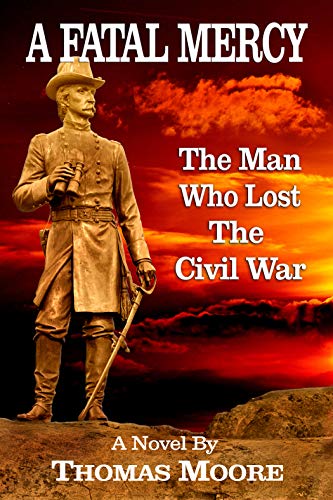
Did you ever have a feeling about a college professor? Maybe a classics professor? (What is it with those, here and at TPC, lately???) Anyway, did you suspect some old man might have, say … lost the War Between the States? Probably not. But, it could have happened. Such is the premise of,
A Fatal Mercy: The Man Who Lost The Civil War
Amazon/Green Altar Books – Shotwell/Tom Moore
Tom Moore is a friend of mine. He is a man of the West, dedicated to more than mere Southern culture, to measured, educated civility itself. And, by “dedicated,” I mean actually willing to resolutely walk where Angels fear to tread. For that alone, I would recommend his novel. Yet, only a modest way into the 727! pages, I am already hooked, materially.
As I told Tom in an email, I really think this is the first Civil War fiction I’ve read since The Red Badge of Courage, some 35 years ago. Fatal Mercy has a Crane feeling about it, maybe something Faulkneresque. This is historical fiction with a high degree of historical accuracy, not unlike the “can’t believe it’s NOT fiction” work of Erik Larson. In other words, it’s a story you don’t want to pause. There’s also another speculation in my mind about Lieutenant Drayton and his titular (in)action. Might his mercy affect the War of Southern Independence as Bilbo’s did the War of the Ring? I have no idea at this point. But, again, this point is very early on. Join me and let’s find out what happens.
Consider this another of my famous book review previews – more to follow, here, maybe at TPC, and on Amazon (5 Stars are a given). Order your copy today – click the above link and/or picture – and get started. She’s $4.95 on Kindle and $19.95 for a trade paperback.
Saw you a-marchin’ with Robert E. Lee;
You held your head a-high, tryin’ to win the victory.
You fought for your folks but you didn’t die in vain;
Even though you lost, they speak highly of your name.
– “Johnny Reb,” Kilgore/Horton (1959)
09 Thursday May 2019
Posted in Other Columns
≈ Comments Off on Spot a Toad in a School
Tags
This is not a tactic endorsement but, rather, a recommendation for a little reading. I’m nominally aware of the Spotted Toad and his career. I owe my knowledge of his new book to Steve Sailer.
While Toad abstains from citing data in his new self-published book, his Thoreauvian reminiscences are informed by the latest findings on genes and IQ, which makes for a subtle and unusual literary combination. Most schoolteachers would rather not think about 21st-century intelligence science, but Spotted Toad can’t ever stop thinking.
The book is 13 Ways of Going on a Field Trip: Stories about Teaching and Learning. It’s $.99 on Kindle, $4.44 for the paperback. Have a look, if you will; I have not read it yet.
It’s about teaching, anecdotes more than statistics. I’m sensing entertainment with a greater message. I understand that it stems from one of the great education fads of this century – Teach for America. A 5-star Amazon review:
Fascinating stories of what a young teacher encountered in New York City schools, mixed in with reflections drawn from the teacher’s own youth and experiences and from his reading. All in all (as my daughter’s fifth grade teacher used to tell the class to end their 3 or 5 paragraph essays), a wonderful read.
Hop … on over.
05 Sunday May 2019
Posted in Other Columns
≈ Comments Off on Pearls Presents Plausible Plan
Tags
09 Tuesday Apr 2019
Posted in Other Columns
≈ Comments Off on Book It
Tags
Mental Floss composed a list of the “best book stores” in every state. I detected a slight leaning or agenda at work. But, hey, it’s books. Read ’em if you can.
20. THE BEST BOOKSTORE IN MARYLAND: SECOND STORY BOOKS // ROCKVILLE, MARYLAND
Second Story Books’s cavernous warehouse in this Washington, D.C. suburb is crammed with used books, rare volumes, antiquarian collections, art and antiques, and much more, all arranged in delightfully specific categories (Byzantine studies or polar exploration, anyone?). Be ready to hunt for buried treasure at 50 percent off the cover price. There’s another, smaller location in D.C.’s Dupont Circle neighborhood too.
Other Maryland Bookstores We Love: The Book Escape (Baltimore), Ukazoo Books (Towson), Normal’s Books and Records (Baltimore)
I noticed some conspicuous absences: Main Street Book Store, Starkville, MS, that second-hand place, McCormick, SC, Andover Books, Andover, MA, the very decent shop at Newburyport, MA, etc. And, of course, there are the ones we lost, like Oxford of Atlanta.
Go read something.
25 Monday Feb 2019
Posted in Other Columns
≈ Comments Off on At Wits’ End: Winter of the West
Tags
Pursuant to last week’s TPC column, I wrapped up At Our Wits’ End, Dutton and Woodley, Imprint Academic, Exeter, UK, 2018.

It’s much worse than declining general intelligence and the end of the Flynn Effect – it’s the end of Western Civilization as we know it. Winter is already underway and there appears to be nothing to stop it.
This will likely feature in a future TPC bit – just submitted this week’s entry on drafting women into the Imperial military (another sign of advanced decay).
The book answers the following tabloid speculation: Scientists fear end to Mankind not ‘decades away’ but ‘much sooner’
OUR CIVILISATION is doing pretty well – but how long do we have left?
Advanced, intelligent society will survive somewhere. It just might not be in GB of the USE.
A sobering but a very good read.
06 Sunday Jan 2019
Posted in Other Columns
≈ Comments Off on Traditional Publishers Dying, Desperate
Tags
Pulling out SJW stops to even offend SJWs, all in a bid to save a few bucks:
When you see publishers and authors chatting chummily at book parties, you’re likely to think that they’re on the same side — the side of great literature and the free flow of ideas.
In reality, their interests are at odds. Publishers are marketers. They don’t like scandals that might threaten their bottom line — or the bottom lines of the multinational media conglomerates of which most form a small part. Authors are people, often flawed. Sometimes they behave badly. How, for instance, should publishers deal with the #MeToo era, when accusations of sexual impropriety can lead to books being pulled from shelves and syllabuses, as happened last year with the novelists Junot Díaz and Sherman Alexie?
One answer is the increasingly widespread “morality clause.” Over the past few years, Simon & Schuster, HarperCollins and Penguin Random House have added such clauses to their standard book contracts. I’ve heard that Hachette Book Group is debating putting one in its trade book contracts, though the publisher wouldn’t confirm it. These clauses release a company from the obligation to publish a book if, in the words of Penguin Random House, “past or future conduct of the author inconsistent with the author’s reputation at the time this agreement is executed comes to light and results in sustained, widespread public condemnation of the author that materially diminishes the sales potential of the work.”
…
This past year, regular contributors to Condé Nast magazines started spotting a new paragraph in their yearly contracts. It’s a doozy. If, in the company’s “sole judgment,” the clause states, the writer “becomes the subject of public disrepute, contempt, complaints or scandals,” Condé Nast can terminate the agreement. In other words, a writer need not have done anything wrong; she need only become scandalous. In the age of the Twitter mob, that could mean simply writing or saying something that offends some group of strident tweeters.
Agents hate morality clauses because terms like “public condemnation” are vague and open to abuse, especially if a publisher is looking for an excuse to back out of its contractual obligations. When I asked writers about morality clauses, on the other hand, most of them had no idea what I was talking about. You’d be surprised at how many don’t read the small print.
If you’re going with a (for now) big house, then read the contract end-to-end and do not sacrifice intellect nor character for feelz. Better yet, run with a smaller Indie or just self publish.
22 Saturday Dec 2018
Posted in Books For Sale
≈ Comments Off on Book Update
Today I’ve been hard at it, editing the forthcoming TPC Column Compendium for 2018. I so enjoy this process. MBM has agreed to give me a fitting Forward. Now, I have to think about adding expanded features and maybe an exclusive bit or two.
Here is (again) the working cover:

Expect this sometime next month at Amazon, B&N, here, and a few other venues. She’ll be around 150 pages and perhaps offered in print for $11.99-ish (less for Kindle). There will be a few pictures.
Ready the credit cards…
18 Tuesday Dec 2018
Posted in Other Columns
≈ Comments Off on The Time Given – clearing the drafts
Tags
***Note*** I’ve got a lot of drafts sitting around, some in existence and unpublished since 2013. It became obvious to me that I’m in no hurry to get around to them. But, they’ve survived various draft purges over the years. If they’re that important I can just come back and elaborate later. For now, I offer them, kind of as-is, in this, a lightning publishing round. The fun will continue while supplies last. Make of these what you will. Or not. I don’t care.
*****
Promo for book … that hasn’t happened yet. As-is a discombobulated draft.
Don’t Worry
Get Fit
Be True
Some si
Simple advice
More to come – some day…
13 Thursday Dec 2018
Posted in Other Columns
≈ Comments Off on A Full Review (and then some) of The Fall of Gondolin
FROM TPC. Here, in full, via direct syndication:
A story a century in the making. A book published 45 years after the author’s death. The latest in a long line of best selling works. Earlier this year came the “completed” master legend of the last days of Turgon’s hidden kingdom. Here follows my account of J.R.R. Tolkien’s The Fall of Gondolin, the good, the great, and the quirky.
But, first, a few notes on how to read Tolkien, especially this tome. A virgin perusal is possible, provided the reader is possessed of what passed for, say, an eighth-grade education, circa 1960. (What that translates to, today, I do not know, though I suspect it leans towards the graduate level). While I’m about to highly recommend the book, I do not recommend it as an initial foray into Arda (the physical World of the Legendarium). Hence,
Start with The Hobbit. Read it at least twice. Then, read The Lord of the Rings (“LOTR”) – cover to cover – to include the important Appendixes. Read LOTR again. Next, read The Hobbit and LOTR, back to back. Then, read The Silmarillion – thrice. The initial criticism of Christopher Tolkien’s editing work will be manifestly obvious and seemingly justified during the initial and subsequent reading. What he painstakingly assembled immediately following his father’s passing at first looks like a neverending cobbling of names, places, dates, and more names. The basis for concern melts with the third reading as a thing of pure majesty presents itself. Somewhere around the twelfth consideration, the work takes on a pleasure all its own as the now academic reader skillfully seeks out well-known favorite passages.
Read The Hobbit, LOTR, and The Silmarillion in succession. Then, and only then, one may (and should) move into The Lost Tales, Unfinished Tales, the various volumes of The History of Middle Earth and other, associated works. Somewhere, during this time, a gander at the various explanatory Letters Tolkien sent is advisable.
Nearing finality in this educational process, one approaches The Children of Hurin, Tolkien’s grand tragedy to rival (I say “to best”) anything by Sophocles. Released in 2007, Hurin fully completes the tale glimpsed in some of the above works, a good novella stretched into a great novel. Hurin also set the stage for the first of two “disappointments” in the saga.
Last year we were treated to the full-length version of that base tale of eternal romance, Beren and Luthien. I say “disappointment” only because, unlike Hurin, Beren is not a completed telling. Rather, it is a “how the story was crafted over many decades” book, literally tracing the development, draft by draft, from WWI until near the time of Tolkien’s death. It’s fascinating, but what you get in the end is essentially the final product recorded in The Silmarillion 40 years earlier. Still, fans, we take what we can get, right?
So it is with The Fall of Gondolin. This is not an end-to-end expose of, perhaps, the most dramatic, action-packed legend in all the annals. But, it does, in primitive and rather disjointed format, link everything together. And, it’s all awesome.
Here, I pause to credit the masterful dedication of Christopher T. in revising, editing, and publishing so much we would otherwise miss. He says, and I believe him, that this is his finale. Then again, he hinted as much when Beren hit the shelves. If this is his end, the end of 70+ year tenure as vice-regent of Middle Earth, so to speak, he’s more than earned the retirement (and all the honor and gratitude we can heap on him). Thank you, Sir!
It occurs to me that more stories lurk in that vast archive housed, in all places, at Marquette University. Something tells me another generation or other appointed editor is already sifting through it. With any luck, a hundred years after people have forgotten the tedious Crowleyisms of Rowling’s inexplicably popular rubbish, they’ll still look forward to something new from the master of the Anglo-Saxon, our Literary Professor Emeritus.
Now – and, thank you for bearing with the preface – on with the book:
I have, here, no real Easter eggs. As I warned, The Fall is not really for the uninitiated, the faint of heart, nor the post-literate. I warped through it, the first time, in about an hour. This is due to: my pre-existing knowledge of the story; my understanding of Christopher’s editing style; the prior reading of Beren; some excellent outside reviews, and; the terrific, easy, and user-friendly layout of the Kindle version.
By the way,

Picture courtesy of Amazon, Tolkien, Tolkien, and Lee!
The first hint the casual reader may discover, of the grandeur of Gondolin, is in The Hobbit. This was the fabled city from whence came the blades of Gandalf and Thorin, originally made for the Goblin Wars. Therein, encircled and protected by near-impenetrable mountains, reigned Turgon, upon a time High King of the Noldorin Elves.
Of Tuor and His Coming Into Gondolin, we know from the Unfinished Tales. Orphaned Tuor, tallest of mortal Men, found the unlikely favor of Ulmo (Poseidon), Lord of Waters. He came to Gondolin following adventures wet and cold. There, he found the favor of the King and the love of his daughter, Idril. Theirs was one of a mere handful of mixed marriages and breedings (of Men and Elves), the progeny thereof being Earendil, future father of Elrond and Elros.
One of the most idiotic of all criticisms limply cast at Tolkien is his alleged forsaking of romance and of strong women. Forgetting, if it’s possible, Eowyn, Arwen, Galadriel, Gilraen, Morwen, Nienor, Luthien, Rose Cotton, “Gimli’s women,” Lobelia, Melian, Varda, Yavanna, and the literally scorching-hot Arien, Idril holds her own against both counts of libel. Her enduring love of Tuor and her unrelenting bravery in the defense of her people and her child suffice. When violently assailed by her wayward and lusting cousin, we learn she fought “like a tigress.” And, her plan was the contingency that saved the remnant, quite possibly preventing the First Age from ending prematurely and with total victory for Morgoth (Lucifer). Tolkien didn’t write weak women. Nor did he write weak fiction.
Not weak, but, as edited by necessity, confusing – hence my approach advice in the delving. The last telling of Tuor’s arrival, essentially that of Unfinished, comes towards the end of this book. A link is provided (in Kindle), instantly redirecting the reader back to near the beginning and the actual Fall of the most beautiful city of Beleriand.
In studying this demise it is helpful to know, in advance, something of how the peoples and the histories converged toward finality, of who made the cut and who didn’t, who became whom, and so forth. The Gnomes, for instance, were working placeholders; the “men” of the Gondolidrim are, in fact, Elves – Tuor being the only actual Man in the Kingdom at the time (though not in history). A healthy peremptory education prevents getting lost in an otherwise incomprehensible tangle of names, races, titles, and descriptions. But, once one has it – whoa!
Now comes the action, more action, and then, some more riveting action. Imagine, those of you of mere LOTR acquaintance, Minas Tirith falling, in spectacular fashion, during Sauron’s assault during The Return of the King. Imagine the peak valor and feats of heroism of that work, augmented and repeated side-by-side over and over again.
In The Fall we learn a bit more about Morgoth’s creation of the dragons, the slithering and winged. We also find out that Balrogs can be slain without the accompanying death of the slayer. Glorfindel (sorry Peter Jackson victims) finds and ends his “buddy” up on the mountainside. Ecthelion takes out three demons in rapid succession, only meeting his end killing the fourth – Gothmog, no less. Tuor slays five and grievously wounds a dragon and does so mostly unscathed.
Towers fall. Wolves run. Eagles fly. Snakes crawl. Evil wins the glorious day (night, rather) only to set up its eventual defeat at the hands of the temporarily vanquished. It’s a wild, violent, noble ride worthy of any acclaim ever aimed at the creation of Eru Iluvatar.
So… Five Stars. Highly recommended. Applause. Buy it today, read it when you’re ready.
And, another hardy thank you to Christopher Tolkien, illustrator Alan Lee, and, especially, to our most prolific Survivor of The Somme, Sir John Ronald Reuel Tolkien. Excellence mirroanwe!

THE Legend. Picture from Biography Online.
You must be logged in to post a comment.